17 Temmuz 2015 Cuma

What's Happening in Black Sea? - June, 2015

Bulgaria

The 150 kilometer-long gas interconnection between Bulgaria and Serbia is to be completed by 2018 so that gas could start flowing in 2019.

Bulgaria’s economy has a 2 % growth in Q1 of 2015, compared to last year. The country’s GDP grew by 0.9 % with € 8.82 billion in Q1. 

According to Deputy Economy Minister, Lyuben Petrov, a Pakistani investor is planning to build a textile factory in Bulgaria, with € 28 million total investment value and 5,000 jobs.

Fitch Ratings on Friday affirmed Bulgaria's long-term foreign and local currency Issuer Default Ratings at BBB- and BBB, respectively. Outlook for both ratings are stable, Fitch said in a statement. GDP growth is projected at 1.2% for 2015 and 1.5% for 2016 respectively.

Foreign direct investment in Bulgaria reached to € 523.5 million in the first four months of 2015, which is forming 1.2 % of the country’s GDP. For the same period last year, FDI was € 426.6. 

Standard & Poor's has confirmed its long- and short-term foreign and local currency rating on Bulgaria at 'BB +/ B' with stable outlook.

International rating agency Moody's has confirmed Bulgaria's rating in terms of government securities - Baa2, noting stable prospective developments.

Georgia

Prime Minister Irakli Garibashvili expects 2% and 3% rise for 2015 and 2016, respectively. Georgian currency Lari lost 30 % its value against $ since November 2014. Georgia has been performing well in terms of economy growth; the country has 5 % average annual growth between 2009 – 2012, 7 % in 2013 and 6 % in 2014. 

Georgia has been ranked among top 25 percent of countries for having an investment friendly country according to International Business Compass 2015. 

The state debt of Georgia since the beginning of the year has dropped $ 173 million making nearly $4.05 billion.

Chinese company Pegasus EastWest has purchased a 230 MW Combined Cycle Thermal Power Plant (TPP) in Gardabani, Georgia’s Kvemo Kartli region for $ 290 million. 

Saudi Arabian Prince Al-Waleed Bin Talal bin Abdulaziz al Saud paid an official visit to Tbilisi and discussed the country’s investment potential. Georgia-Saudi Arabia trade turnover was $ 3.6 million in the first four month of 2015.

The number of tourists who visited Georgia grew by 15% in May comparing to same period last month. In May, 454,545 tourists visited Georgia, according to country’s National Tourism Administration.

The International Finance Corporation (IFC), a member of the World Bank Group, has provided Bank of Georgia with a 10-year subordinated loan totaling $90 million, of which $20 million was provided by the European Fund for Southeast Europe, in order to help expand financial services in Georgia and increase the flow of credit to micro, small and medium enterprises.

According to the National Statistics Service, Georgia's economy has slowed sharply to grow 2.6 percent in the first four months of this year compared with 6.2 percent in the same period last year.

Greece

The Organization for Economic Cooperation Development expects a decrease in its global growth forecast due to the result of a possible Greek default. OECD announced 3.7% expand in world economy last October, which has been modified to 3.1 %. 

After Alexis Tsipras’s announcement for a referendum in order to let Greeks decide about bailout plan, Greek banks are closed. Daily withdrawal limits are set at 60 €. 

Standard & Poor’s has downgraded Greece’s credit rating to CCC from CCC+ which pushes Greek bonds one step further into junk territory, with a negative outlook. 

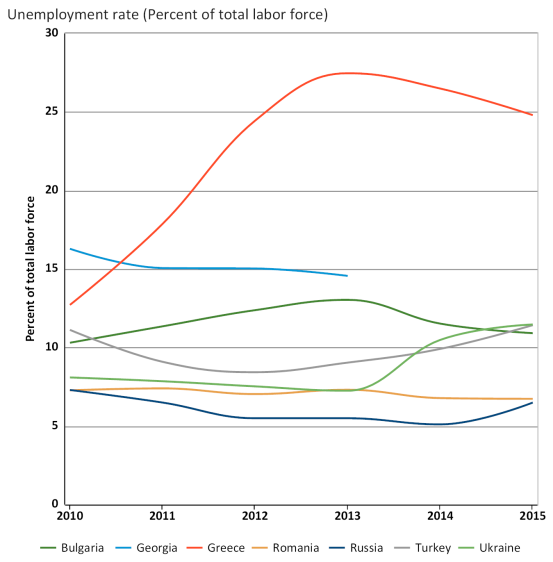
Unemployment rate in Greece rises to 26.6% in the first three months of the year, which was 26.1 % in the previous quarter. 71.6% of 1.27 million jobless in Greece are long-term (at least 12 months) unemployed.


Romania

With the strong recovery in construction sector in Romania, Garanti Bank expects a 2.5% increase in country’s GDP this year. 3.6% rise in the constructions helped inflation rate to drop to 0.4% from 0.5 in 2014, according to the Bank. 

Romania is looking for new joint projects with Kazakhstan in terms of energy, tourism, transport, agriculture, research and education. Kazakhstan, one of the main exporters of Romania, had over $ 3 billion in 2014, whereas Romania replied with only $ 84.3 million with 60% increase. Romania’s main import area from Kazakhstan is oil, which is used by Rompetrol Group. 

The State Oil Company of Azerbaijan Republic (SOCAR) plans to double its investments in Romania in next two years. With its 32 stations, the company hired around 500 people in Romania since 2011.

Rompetrol Rafinare, part of Kazakh group KMG International announced it completed 11 million worth investment targeting the reduction of powder emissions in the open air. The investment materialized in operating the first particle separation installation in Romania. 

Romania’s Prime Minister Victor Ponta is currently troubled with allegations of forgery, money laundering and complicity in tax fraud. Romanian economy is accepted as the second biggest shadow economy in European Union. 

Romania’s GDP amounted to some EUR 31.3 billion in the first quarter of this year, up 4.3% over the same period last year. Wholesale and retail trade, car and motorcycle repair, transport and storage, hotels and restaurants contributed 1% to the economic growth in the first three months. They had a 17.8% share in the GDP, and their volume of activity went up by 5.8%.

Since 2002, Romania has attracted € 22 billion foreign direct investment in energy sector. 

Canadian investment vehicle Transeastern Power Trust has agreed the acquisition of two solar parks in Romania, from RG Renovatio Group, for about $ 9.6 million (€ 8.5 million), excluding debt. 

Russia

According to the Central Bank of Russia, Russian banking sector reported net losses of 20 billion rubles ($380 million) in April.

After 2.7 % monthly decrease in March, Russia’s GDP shrank by 4.2 % in April compared with 2014.

Venezuelan President Nicolas Maduro announced that he had reached an agreement with Russia's top oil producer Rosneft in which $14 billion would be invested in Venezuela's oil and gas production. 

In order to boost army force, Putin plans to spend over $ 400 billion until 2020, although the country is in a recession. 

Deutsche Bank, one of the largest foreign securities firms in Russia, considers cutting about 100 jobs in Russia, due to the fact that country’s current performance in economy slowed dealmakers down. 

Saudi Arabia and Russia have signed a $10 billion memorandum of understanding between their public investment funds in yet another high level deal between the two countries.

Moody's Ratings Service has said that large Russian corporations have $ 40 billion worth of debt maturing this year and a further $60 billion of repayments due between 2016 and 2017. 

The World Bank has updated its economic outlook for Russia; the new most likely scenario is more optimistic and assumes an average oil price of $ 58.0 per barrel for 2015 and of $ 63.6 per barrel for 2016. On this basis, real GDP is projected to contract by 2.7 percent in 2015, before reaching 0.7 percent in 2016, and 2.5 percent in 2017.


Turkey 

Exporters Assembly of Turkey has expressed that Turkey’s exports decreased by 19% with $ 10.82 billion in May 2015, compared to last year. 

Turkcell, the biggest telecommunication company in Turkey, announced that they are buying out Ukrainian mobile network, Astelit, which trades under the "Life :)" brandname for $ 100 million. Turkcell currently owns 55.04% of the. 

Total R&D spend, including that of the private sector, in research and development in the country increased by 13.4 percent reaching 14.8 billion Turkish liras ($ 6.6 billion) in 2013 compared with the previous year. 

Sberbank agrees to lend funds for Istanbul's new international airport. According to the IGA website, the airport will contribute 22.2 billion euros ($ 25.3 billion) over 25 years to the Turkish state. It is estimated that 100,000 people will be directly employed at the airport, while 1.5 million others will be employed in sub-sectors. 

The Export-Import Bank of Korea (KEXIM), a policy bank and government institution wholly owned by the Korean government, has provided credit of $280 million for the Eurasia Tunnel and a guarantee of $ 101 million for the third Bosporus bridge project. As of 2014, the number of Korean companies in Turkey was over 100 while the amount of the investments of Korean companies was over $1 billion in Turkey until last year. 

According to Invest in Turkey, an investment promotion agency that sits under the authority of the prime ministry, Turkey attracted $ 12.5 billion in total FDI in 2014 against $ 12.4 billion the previous year and $ 13.2 billion 2012. 

The Central Bank of the Republic of Turkey (CBRT) reported that Turkey's current account deficit dropped $ 1.5 billion to $ 3.4 billion in April, compared to the same month the previous year, yesterday. The 12-month rolling deficit decreased to $ 44.2 billion from $ 45.7 billion. 

According to World Bank, Turkey ranked second after Brazil in making the highest commitments for total infrastructure investments among 139 emerging countries in 2014. 

Turkey’s Central Bank expressed that the volume of direct Azerbaijani investments in Turkey has tripled compared to the same period of 2014, and stands at $ 277 million.

Ukraine 

Since the critical war with Russia is still on, IMF expects Ukraine’s economy to shrink 9 % this year and inflation to rise by 46 % at the end of 2015. 

Under the energy efficiency program, Ukraine hopes to receive € 400 million from European Investment Bank (EIB). 

Ukraine’s GDP contracted by 6.8 % in 2014 and expectation for this year is even worse: 9 % decrease.

Transparency International ranked Ukraine last in Europe according to their corruption perception index; the country’s performance is almost same with Nigeria and Papua New Guinea. 

According to World Bank data, Ukrainians working abroad contributed $ 7.5 billion annually to the country’s economy last three years. 

The EBRD provided a loan of up to $ 60 million to Brooklyn-Kyiv LLC, a leading private stevedoring company in Ukraine for a grain trans-shipment terminal in the Port of Odessa. The European Bank for Reconstruction and Development invested a record € 1.2 billion in Ukraine last year.


15 Temmuz 2015 Çarşamba

Sinop Ekonomi Verileri (Ocak-Mayıs, 2015)

Mayıs ayı sonunda 2014 aynı döneme kıyasla Sinop ihracat verilerinde %37’lik azalma görülürken, ithalatta ise %70’lik artış söz konusudur. Son 5 yılda ilk kez ihracat ile ithalat arasındaki makas kapanma noktasına gelmiştir.

Özellikle makine imalatı alanında firmaların Sinop’ta etkin faaliyet göstermesi ile 2015 ilk 5 aylık dönemde makine ihracatı en büyük kalem olarak ön plana çıkmaktadır. İthalatta ise hayvancılık için ihtiyaç duyulan hayvan yemine talepte artış devam etmektedir.

Sinop’un en büyük ihracat partnerlerinden Almanya ve Rusya 2015’in ilk 5 ayı sonunda da bu alanda ilk iki sırada yer alırken, ithalatta ise Sinop’un bu yılki ithalatının yaklaşık %50’si Gürcistan’a gerçekleştirilmektedir. 

Mayıs ayında 1 adet yatırım teşvik belgesi düzenlenmiş olup, 2015 geneli 2014 yılına kıyasla yatırım anlamında daha zayıf geçmektedir. 

Açılan firma sayısında ilk 5 ay sonunda %26’lık azalma görülürken, kapanan firma sayısında ise artış bulunmaktadır. 

2015 yılında konut satış rakamlarında aylara göre artış trendi Mayıs ayında sona ermiştir, Mayıs ayında %10’luk azalma söz konusudur. Geçen yılın ilk 5 ayına göre toplamda ise 1086 konut satışıyla %25’lik artış gözlemlenmektedir.

Sinop Organize Sanayi Bölgesi doluluk oranı %66, Boyabat ise henüz %17 seviyesindedir.


18 Haziran 2015 Perşembe

Tsipras’s Effects on Greek Economy (Analysis for January – June Period)

After the elections held on 25th of January this year, Tsipras’s SYRIZA finally had a chance to take Greece back to its bright days initiated with joining the European Union (EU). In his 5 months long governing period, it is possible to say that sky is not clear yet. Even though there were significant promises during the election campaigns, SYRIZA could not help but face with the reality of Troika, triangle of International Monetary Fund (IMF), European Central Bank (ECB) and European Commission (EC). Still, according to the recent polls, Greeks are still confident in Tsipras and his decisions. And indeed, opposition parties have been patiently (recently not) waiting their chances to prove that Greece could actually survive from this nightmare. Or there will be a solution?

Let’s have a quick look on Greece’s current government structure. Current government was formed by SYRIZA as the leading party working together with The Independent Greeks (ANEL) while New Democracy (ND), Golden Dawn (XA), The River (To Potami) The Communist Party of Greece (KKE) and The Panhellenic Socialist Movement (PASOK) took seats as opposition parties. Still, SYRIZA controls the significant decisions – making ministries in both interior and foreign policy, so that it is safe to refer economic progress of Greece in January – June period as a result of Tsipras’s decisions.


There are already rumors that Tsipras might ask for an early election, since it seems recent talks with EC and IMF do not lead to anywhere. Varoufakis, Greek Economy Minister, expressed that Greece will not be able to pay latest debts to the Troika which was not supported by Lagarde, the head of IMF.

Here is the schedule for Greek debts which lasts until 2054. Critical ones are marked grey as debts to Treasury bill holders, red as to IMF and blue as to ECB. Greece owes € 131 billion to European Financial Stability Facility, € 53 billion to Eurozone Governments, € 34 billion to Private Investors, € 27 billion to ECB, € 21 billion to IMF and € 15 billion to Treasury Bill Holders with a total of € 281 billion. Debt to European Investment Bank is neglected due to its amount comparing with others (€ 25 million to be paid in July).


Recently, talks between Greece and Troika are likely to end without a resolution and these three months could be the most dangerous ever to Greek economy. As a reminder, during June – August period, Greece will pay € 7 billion to TBH, € 2 billion to IMF and € 5.63 billion to ECB.

Greek unemployment has been stable: the 25.6% of unemployment rate stays unchanged during Tsipras’s government. Beside the debt, unemployment is the biggest problem Greece has been fighting with since 2009. SYRIZA managed to stop the increase trend of unemployment but could not accomplish to decrease it either. Youth unemployment rate is still around 50%, one of the worst with Spain in EU.


What about stock market response? Athens Stock Exchange (ASE:IND) had ups and downs last month and closed the mid June with 733.24 which was around 850.00 when SYRIZA took in charge. Foreign investors are leaving the market and destabilization in both € and $ also threatens investors in Greece.


Greek long term interest rates rose since January and reached its peak (13.6%) in April. When Tsipras formed the government, it was 9.09%.


Greece sovereign credit ratings according to S&P’s, Moody’s and Fitch are CCC, Caa2 and CCC, respectively, which all indicate “lower than investment grade”. Foreign Direct Investment (FDI) in Greece decreased to € -68.70 million in March of 2015 from € 4.70 million in February of 2015. FDI in September was € 4.5 million and increased continuously to € 216.9 million in January when SYRIZA started. But at the end of March, Greece saw the bottom in terms of FDI.


To sum up, both economies and politicians focus on the negotiations between Greece and Troika. Good sign (means delaying debts) also delays the possibility Greek default, and maybe the bigger crises further in both economic and social issues. And the bad sign? Well, frankly, most of EU leader, European investors and Greek politicians would not desire it at this very fragile time.

Last but not least, an early election - indeed, it is possible. PASOK has a new leader, Fofi Gennimata, and the party will strive to find a way to rule Greece as they did five years ago with Papandreou, or ND did with Samaras, who was the former Prime Minister and had to step down after the elections. 

All eyes are on Tsipras’s performance right now. We will have some answers until the end of these three months, or maybe in this very June, to know if Greece sees a light at the end of the tunnel or not. 

11 Haziran 2015 Perşembe

What's Happening in Black Sea? - May, 2015

Bulgaria 


Hewlett Packard (HP) invests € 5.1 million technology lab in Sofia. HP already hired 6.000 professionals in the last 9 years in Sofia. 


Fitch downgraded Bulgaria’s First Investment Bank (Fibank) to B- from BB- with the outlook as “stable”. Now Fibank’s long term issuer default rating B- from BB-. 

Turkey’s biggest online food-ordering portal (yemeksepeti.com) expands to Bulgaria and Romania. Yemeksepeti will be making investments in online portals bgmenu.com in Bulgaria and quicky.ro and oliviera.ro in Romania, aiming to become the industry leader in the two countries. 

Japanese manufacturer of car cabling systems Yazaki opens 3rd plant with € 30 million investment. Company has already invested € 60 million since 2006. 

Bulgaria’s FDI in 1st Q was recorded as € 317.3 million, which is 0.7% of its GDP. In the same period last year, country attracted € 346.5 million. 

If elections held today in Bulgaria, ruling party Citizens for European Development of Bulgaria (CEDB) gets 23.8% while Socialists and Movement for Rights and Freedoms take 14.7% and 8.0%, respectively. 

Port Burgas absorbs € 12 million investment at the end of 2015 when two new yachts are to be built. With its 230 employees, the port celebrates its 112th anniversary on 18th of May. 

Georgia

Georgia’s GDP growth keeps shining. In 1st Q, GDP rose 2.6%, with the 0.9% increase last month alone.

Due to current crisis in Russia and unstable oil prices, IMF downgraded economic growth forecast to 2.6%, previously it was 3.0%. 

Arabian Dhabi Group, focusing banking and tourism sectors, announced extra $ 250 million investment in Georgia with increasing its investment portfolio by 35%.

European Union unblocked € 2 billion investment for small businesses in Georgia, Moldova and Ukraine.

Greece

Greece is in "middle income trap". A recent paper from Asian Development Bank (ADB) mentions that Greece has been struggling to exit from middle income trap. Greece which became upper middle class in 1972, has found herself as "top income" league in 2000. According to the atlas of economy of complexity, Greece ranked 48th in terms of index of complexity of reports, which is the lowest in Europe. 

During Tsipras's visit to Russia, Putin has offered Greece to be a member of BRICS, consisting of Brazil, Russia, India, China and South Africa. Tsipras will attend Economic Forum held on June 18th-20th in St. Petersburg, Russia to discuss matters.

According to the latest polls in Greece, results still favor for Syriza with 36.5% while New Democracy gets 15.5%. %50 of Greeks support Tsipras and Kommenos as an independent leader gets 25.5%. 

As the part of "Silkroad Investments", Chinese Cosco company invested € 4.3 billion in Piraeus port to operate port's contain terminal for 35 years. Piraeus port is strategically important as being a key hub for maritime transportation. Investments by Cosco has been increased 5 times since 2009 until 2013. 

European Union (EU) assumes merely 0.5% growth for Greece this year. In order to reach the estimations, European Bank of Re.. and Development has agreed to have $ 500 million investment deal with Greece. 

Interconnector Greece Bulgaria (IGB) gas pipeline agreement will be signed on June 12th. The agreement includes a 182 km-length gas pipeline project which enables Bulgaria to allow Azerbaijani gas. 

Greek Minister of Economy Varoufakis believes that Greece cannot afford IMF repayments in June, which is € 1.6 billion. There are rumors that Varoufakis has already been sidelined by Tsipras. Currently all discussions with troika must be agreed by Tsipras personally. 

Greece is bleeding € 22.3 million every single day. Since Tsipras took charge in January, 59 businesses shut down with 613 people losing jobs per day.


Greece debt in numbers
  • € 320 billion total debt
  • € 240 billion European bailout
  • € 56 billion Greece owes to Germany
  • 177 % country's debt to GDP ratio
  • 25% fall in GDP since 2010
  • 26% unemployment rate


Romania

Romanian FDI increases %55 in the 1st Q to € 885 million. Country attracted € 2.43 billion last year with 10.6% decrease by 2013. Largest FDI recorded in Romania’s history was in 2008 with € 9.5 billion.

Romania’s largest lender Banca Comerciala Romana (BCR) gets 50 million $ credit from World Bank (WB). BCR plans to use the money to offer new financings for importers and exporters in Romania. 

Romania expects the Transatlantic Trade and Investment Partnership (TTIP) to have a great impact on its economy. While the negotiations continue, Romania estimates TTIP to add 0.25% to the growth annually while increase 35% in exports and 25% in imports.

Russia

Russian Economy Minister Alexei Ulyukayev mentions that there will be 2.3% - 2.4% expand each year in 2016-2018 period, with the help by recovering oil prices to reach $ 70 per barrel by 2016, which is currently 60 $. However, Ulyukayev expects this year contract by 2.8%.

Rosneft, Russia’s top oil producers agreed to invest $ 14 billion in Venezuela’s oil and gas sector.

Turkey 

Industrial and Commercial Bank of China (ICBC) becomes the first Chinese bank in Turkey. ICBC purchased 75.5% shares of Turkish bank Tekstilbank for $ 254 million. 

Turkish FDI decreased 19% in the 1st Q from $ 4.26 billion to 3.45. FDI falls by more than third (37.0%) from $ 1.42 billion to $ 900 million in March. 

Ordu-Giresun Airport, first airport on artificial island in Turkey and Europe and 5th in the world, was completed in 4 years with $ 132.6 million. Turkey plans to have 60 airports by 2023.

Turkey hosts 41 million visitors in 2014 with $ 3 billion income annually. Continuous growth of Turkish Airlines has a significant impact on the 5.6% increase of visitors to the country.

Ukraine 

Economists warn Ukraine that the country could see its economy shrink by 5.5% to 10.0% in 2015. According to the latest expectations from IMF, Ukrainian economy decreases 5.5% at the end of the year. In addition to the aid from European Union, IMF also pumped $ 17.5 billion into the country. There are also rumors that Ukraine could find itself into moratorium.


Not only in the battle field but also in the economic war, Ukraine is losing to Russia. Ukraine and Russia had the same GDP in 1990 and the GDP gap between these countries is now much greater.


Graphs from Black Sea Region


  • External Trade


  • Foreign Direct Investment


  • GDP


  • Unemployment


  • Markets


  • Energy


  • Population

  • Tourism


  • Military

Source: www.knoema.com, www.worldbank.org 


13 Şubat 2015 Cuma

Sinop’un 2014 Yılı Dış Ticaretine Genel Bakış

Türkiye İstatistik Kurumu (TÜİK) 2014 yılı dış ticaret verilerini geçtiğimiz günlerde açıkladı. Rakamlara göre Sinop ilinin ihracatı 25,8 milyon $ olurken, ithalat ise 6,9 milyon $ olarak ifade edilmiştir. Verilere göre en önemli husus, 2013 yılına göre Sinop ilinin hem ihracatında hem de ithalatında azalma görülmektedir. Dış ticaret verileri illerin nüfusuna göre oranlandığında ise Sinop ihracatta birey başına 126,3 $ ile 62. sırada, ithalatta ise yine birey başına 33,7 $ ile 73. sırada yer almaktadır. Hem il geneli hem de birey başına düşen dış ticaret verilerinde Kastamonu, Çankırı ve Sinop illerini kapsayan TR82 Bölgesi’nde Sinop son sırada yer almaktadır.


Sinop ilinin ihracat rakamlarının genel olarak düşük olmasında elbette bazı sebepler yer almaktadır. Bunlardan en önemlisi, Sinop’ta faaliyet gösteren büyük firmaların merkezlerinin İstanbul’da yer alması ve dolasıyla ihracat / ithalat rakamlarının İstanbul iline yansıtılmasıdır. Sinop’taki firmalar ile yapılan görüşmelerde bu açıdan her yıl yaklaşık 5-6 milyon $ eksik ihracat söz konusu olabilmektedir.

İhracatın 2013 yılına göre 6 milyon $ daha az olmasının en önemli sebebi ise Rusya-Ukrayna arasında yaşanan siyasi gerilimdir. Halen devam eden savaş hali bu iki ülke ile ticaret yapan ülkelerin de olumsuz etkilenmesine neden olmaktadır. Özellikle Sinop ilinin her yıl en büyük ihracat partneri olan Ukrayna’ya 2014 yılında gerçekleştirilen ihracatta büyük düşüş yaşanmıştır; 2010 yılında Sinop’un Ukrayna’ya olan ihracatı 18 milyon $ iken, 2014 yılı sonunda bu rakam 1,6 milyon $’a gerilemiştir.

2013 yılında Uzakdoğu’ya (özellikle Japonya ve Güney Kore) yapılan ihracat en üst seviyeye ulaşırken, 2014 yılında bu iki ülkeye ihraç edilen su ürünlerinde yaşanan azalma ihracat rakamlarını da etkilemiştir; Japonya ve Güney Kore’ye geçtiğimiz yılsonunda yapılan toplam ihracatta yaklaşık %50 azalma görülmektedir.


Sektörel anlamda Sinop’ta 2014 yılının en büyük ihracat kalemi örme giyim eşyası olurken, yaş meyve ve sebze ihracatında büyük düşüş gözlemlenmektedir. Örme giyim alanında Sinop’ta son dönemde yapılan yatırımlar ve firmaların fason üretim ile birlikte daha çok ihracat gerçekleştirmesi son 5 yılda bu sektördeki ihracatın yaklaşık 17 katına ulaşmasına olanak sağlamıştır. Her ne kadar Sinop’ta üretilmese de firma merkezleri Sinop’ta olduğu için dış ticaret verileri Sinop iline yansıtılan yaş meyve ve sebze ihracatı ise son bir yılda 7 milyon $ kayıp yaşamış olup, Sinop’un ihracat rakamlarına negatif yönde etki etmiştir.


Yeni sektörler ile birlikte coğrafi dağılım da incelendiğinde 2014 yılında Sinop’un dış ticaretinde eksen kayması da görülmektedir. 2014 yılı sonunda Sinop’un en önemli ihracat partnerleri Avrupa ve Asya (özellikle Uzak Doğu) olurken, ithalatın ise neredeyse tamamı başta Çin olmak üzere Asya ve Avrupa ülkeleri tarafından gerçekleştirilmiştir. Bölgesel olarak inceleme sonucunda ortaya çıkan en önemli husus; daha önceki yıllara kıyasla artık Avrupa pazarı Sinop ili için daha önemli bir konuma gelmesidir.


Genel olarak bakıldığında 2013 yılına göre dış ticarette daha olumsuz bir hava izlense de 2015 yılında faaliyete geçecek yeni yatırımlar ile Sinop’un ihracat rakamlarının daha yüksek olması beklenebilir. Rusya-Ukrayna arasındaki gerilimin azalması özellikle Ukrayna pazarının yeniden kazanılması anlamında Sinop için oldukça önemlidir. Ayrıca Almanya ve İngiltere gibi Sinop’un ihracatında öne çıkan ülkeler ile ticari anlaşmaların devam etmesi ve geliştirilmesi “kaliteli” üretim ve ihracatı anlamında not edilmelidir. Sinop’ta çıkarılan su ürünlerinin 2015’te artması, çeşitlendirilmesi ve yine Uzak Doğu pazarına yönlendirilmesi daha yüksek ihracat rakamları getirebilir.


29 Ocak 2015 Perşembe

Sinop için Yeni Ekonomi Alanı: Kruvaziyer Turizmi

Uzun seyahatler için en çok tercih edilen havayolu ile ulaşım her turist için cazip gelse de teknolojinin getirdiği tüm olanakları sunan yeni dönem gemi turları ve son dönemlerde bu turlara gösterilen talep dikkat çekmektedir. 2013 yılında dünya turizminden sadece %2 oranında kruvaziyer turizminin pay aldığı düşünüldüğünde bu pazarın ilerleyen yıllarda çok daha fazla büyüyebileceği öngörülmektedir.
Sinop için de turizmin bu alanı yeni bir sektör olarak ön plana çıkmakta ve her geçen yıl yerel turizm otoriteleri ile birlikte yerel esnaf ve halk da kruvaziyer turizminin Sinop’a kazandırdıklarına daha fazla önem vermektedir. Bu yazıda Sinop’un kruvaziyer turizmi performansı ve Türkiye’nin bu alandaki gelişimi Deniz Ticareti Genel Müdürlüğü’nden alınan veriler ışığında özet olarak değerlendirilmektedir. Verilere göre Sinop Limanı’nın 2008 yılından itibaren kruvaziyer gemileri ağırlamasından ötürü Türkiye verileri de bu yıldan itibaren incelenmiştir.

Türkiye’ye gelen gemi sayısının 2008-2014 yılları arasındaki değişimi incelendiğinde, kruvaziyer sayısında dalgalı bir grafik izlendiği görülmektedir. 2013 yılında ülkeye gelen gemi sayısı azalsa da yolcu sayısının bir önceki yıla göre arttığı ve yaklaşık 2,24 milyon yolcu ile bu zamana kadarki en yüksek rakama ulaştığı görülmektedir. Ancak 2014 yılında ülkemize gemiyle gelen yolcu sayısında yaşanan %20’lik düşüş sektörde de yaşanan sorunu ortaya çıkarmaktadır.


Sinop’a gelen gemi sayısında ise 2011’den itibaren artış görülmekte ve son iki yılda Sinop’a gelen gemi ve yolcu sayısında iki kat büyümeler izlenmektedir. 2014 yılında Sinop’a gelen hem gemi sayısında (30) hem de yolcu sayısında (17.520) bu zamana kadarki en yüksek rakamlara ulaşılmıştır.


Kruvaziyer turizmin özellikle ilkbahar ve yaz dönemlerinde daha çok talep edilmesinden ötürü 2014 yılında Türkiye’ye Mayıs-Ekim aylarında bu alanda yoğunlaşmanın olduğu, Kasım-Nisan aylarının ise oldukça sönük geçtiği görülmektedir.


Aynı grafik Sinop için de söz konusu olup, 2014 yılında Sinop Limanı’nın Haziran – Ekim ayları arasında gemi ağırladığı, yolcu sayısında ise Eylül ve Ekim aylarında büyük artışların olması dikkat çekmektedir.


Karadeniz’in Türk kıyılarına gelen gemi sayıları incelendiğinde ise Trabzon Limanı’nın 2008-2014 yılları arasında en fazla gemi ağırlayan liman olarak ön plana çıkmaktadır. Sinop ise ağırladığı gemi sayısındaki artış ile yıllar geçtikçe Trabzon’a yaklaşmakta olup, aradaki fark 2014 yılında neredeyse kapanmıştır. Yine bölgede Bartın’ın Samsun’u geçmesi de yine önemli notlar arasında yer almaktadır.


Özellikle Rusya ve Ukrayna’da yaşanan politik kriz, 2014 yılında Karadeniz’in Türk kıyılarına daha fazla kruvaziyer gelmesine olanak sağlamıştır. Sinop Limanı’nın ulusal ya da uluslararası arenada doğrudan organize ettiği bir tanıtım çalışması olmamasına rağmen özellikle son yılda 30 gemi ağırlaması, Sinop Limanı’nın Karadeniz’de en uygun kruvaziyer limanlarından biri olması açısından önemlidir. Karadeniz’deki diğer limanlara (Köstence, Yalta, Soçi vb.) konumu itibari ile neredeyse eşit uzaklıkta olan Sinop Limanı, etkin bir tanıtım ile halihazırda tur düzenleyen firmaların daha fazla gemi getirmesi ve farklı gemi acentelerinden de tur çekmesi sağlanabilir.

16-19 Mart’ta Amerika Birleşik Devletleri’nin Miami kentinde gerçekleştirilecek Kruvaziyer Gemi Fuarı’na ilk defa katılacak olan Sinop, bu fuar süresince kamu ve özel sektörün işbirliği içerisinde gerçekleştireceği ikili görüşmeler ile 2015 ve 2016 yıllarından itibaren Sinop’a daha fazla kruvaziyerin getirilmesini hedeflemektedir. Bu fuar ile birlikte özel sektörün turizmin bu popüler alanına yönelik çalışmalarını arttırması ve yeni yatırımlar planlaması yine temel beklentiler arasında yer almaktadır.